Conventional Displays: Discrete Refresh
One of the most surprising aspects of electrophoretic displays (EPD, better known as E-Ink) is how images are formed. Unlike conventional LCD or OLED screens, where pixels are refreshed electronically dozens of times per second, an E-Ink display builds the image physically, particle by particle.
E-Ink Displays: Fluid Formation
E-Ink technology works differently. Each pixel contains black and white charged particles suspended in microcapsules. When voltage is applied, particles move physically to the top or bottom of the capsule, creating visible black or white.
This is why handwriting on E-Ink feels unique: the line appears gradually, fluidly, as particles reposition. In our prototype video captured at 30 fps, the handwritten line is formed over several consecutive frames. Even though there is a measurable delay, it is not perceived in the same way as on LCD/OLED — because the image is continuously “growing” under the pen tip instead of appearing in discrete jumps.
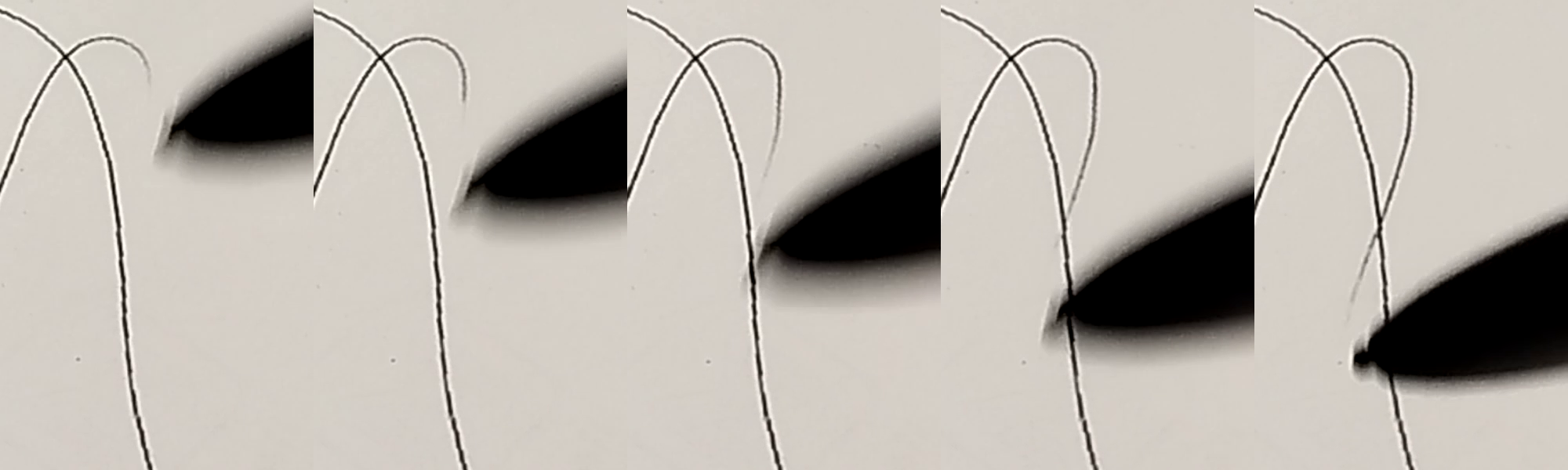
Dual Pipelines: Memory vs. Screen
Working with EPDs reveals another important difference: the system maintains two separate images. One is stored in memory, used for saving and later processing. The other is rendered directly to the screen.
Unlike the classical pipeline — screen → display controller → processor → back to display — handwriting on E-Ink seems to use a short-circuit pipeline: screen → display controller → screen. The display controller triggers the electrophoretic response directly, while the processor updates the memory buffer separately.
This dual-path architecture explains why strokes can appear instantly on the E-Ink surface, even on modest hardware, while still being recorded at higher resolution for storage and synchronization.
Why It Matters for Evonote
For education, this difference is crucial. It means that a digital notebook like Evonote can deliver smooth handwriting experience with minimal processing power. As shown in our prototype analysis, rendering on E-Ink required only 5% of RAM and 25% of CPU, compared to the heavy demands of traditional tablets.
In practice, this allows Evonote to:
- Provide a handwriting experience close to paper.
- Protect the eyes with a display that behaves more like ink than light.
- Operate on modest hardware, lowering costs and increasing accessibility.
Evonote builds on this strength. By embracing the specific nature of E-Ink — its fluid rendering, its dual pipelines, and its minimal resource demands — we create a tool that preserves handwriting while enabling digital storage, sharing, and analysis.